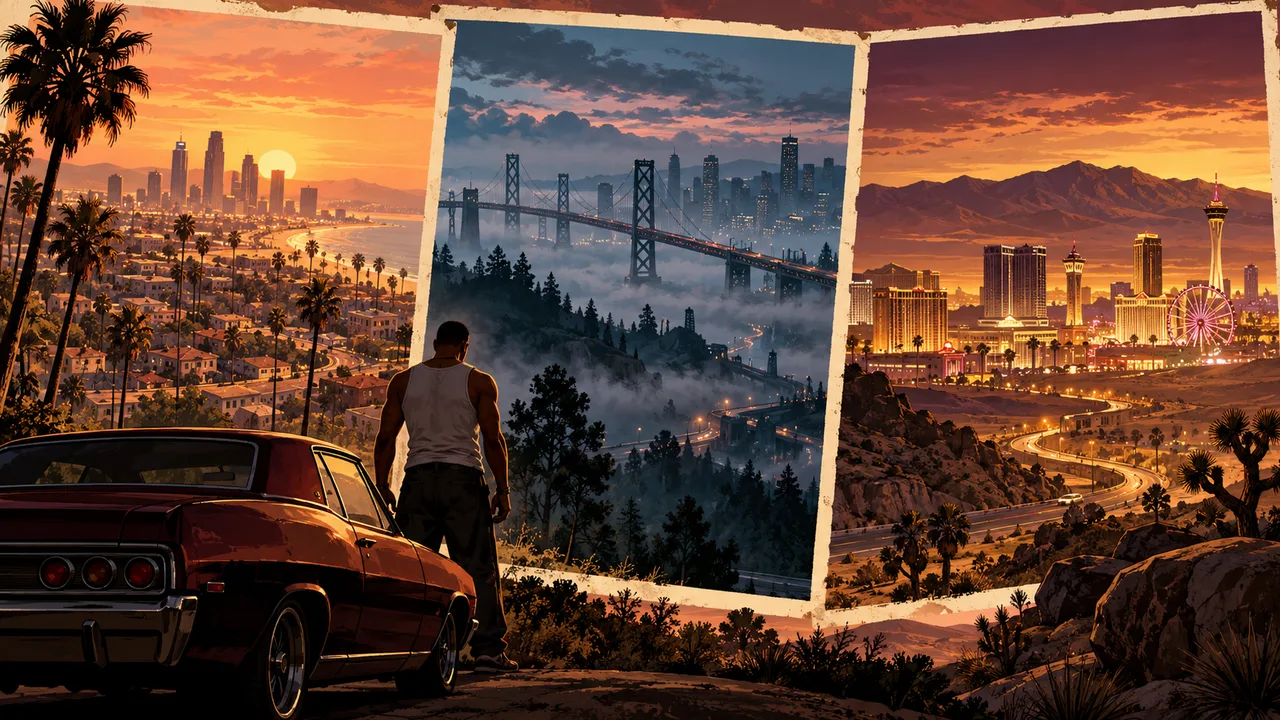
For GTA 6 readers interested in what makes a large setting memorable, Grand Theft Auto: San Andreas offers a useful historical case. Rockstar’s manual identifies three principal cities: Los Santos, San Fierro and Las Venturas, alongside landscapes beyond the urban areas. Rockstar’s manual.
The manual associates the cities with different kinds of activity and identity: celebrity culture, an artistic community and casino spectacle. It also describes mountains, forests and deserts. Those distinctions explain variety without needing an unsupported comparison of square kilometers.
A city is also a stage in a journey
Rockstar’s own gameplay tips connect clothing-store availability to progression between locations. The advice names Zip in San Fierro, Victim after the move to Las Venturas, and Didier Sachs on the return to Los Santos. This is a concrete example of geography being tied to progression rather than serving only as a backdrop. Rockstar Support’s San Andreas tips.
What to carry into a comparison
Our suggested checklist is experiential: how does a place look, what do you do there, and when does the story give you a reason to visit? Two areas of similar apparent size can feel very different if those answers change.
That is historical context, not a prediction that GTA 6 will repeat these shops, its progression structure or the older map. A familiar franchise can revisit the idea of regional contrast without copying its earlier implementation.
When comparing games, label the exact title and edition. A remembered place name is a useful starting point; it is not a substitute for checking which version of that place you mean.
Prepared with AI assistance and checked under our editorial standards. Corrections are welcome.